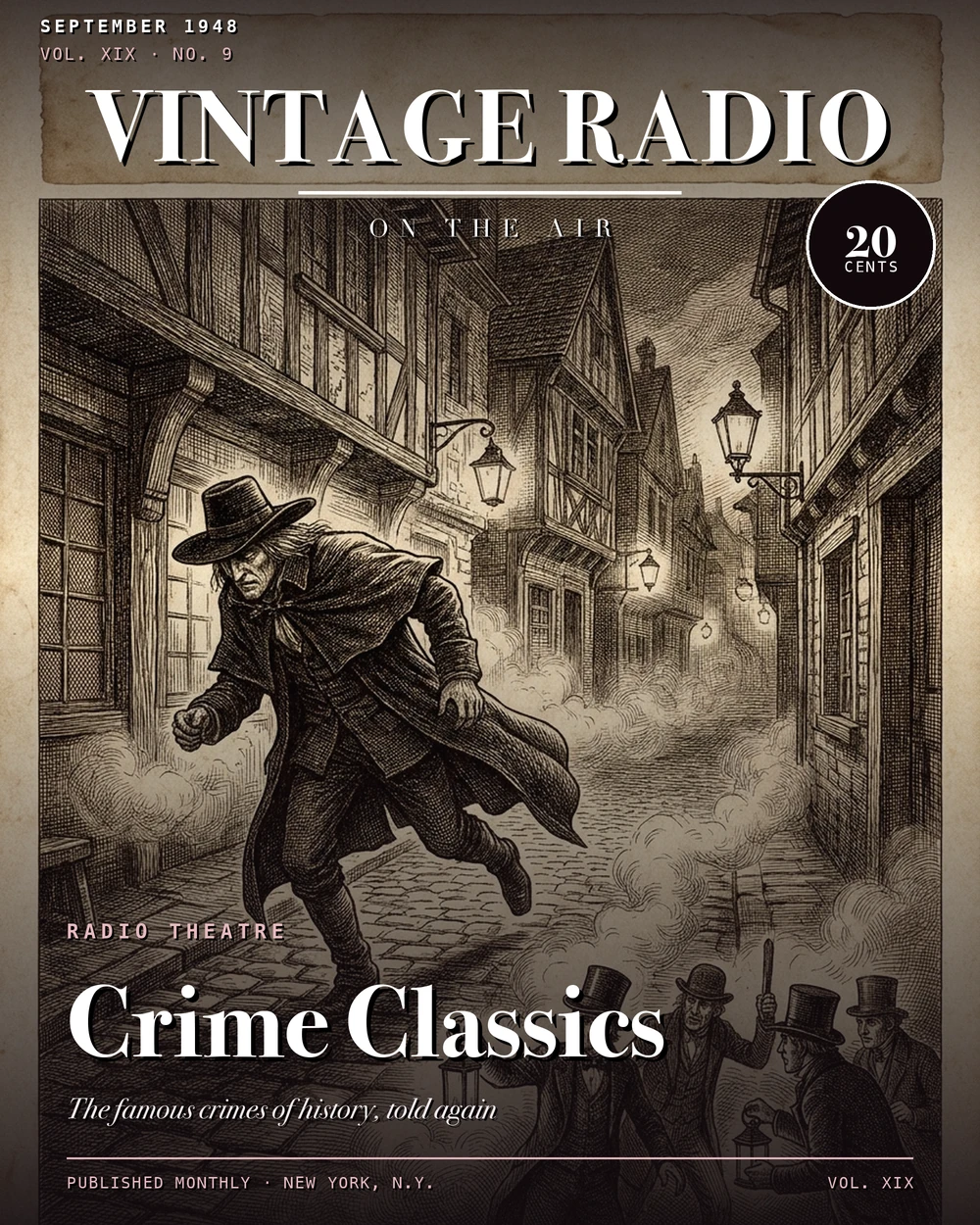
Crime Classics
Thomas Hyland and the Sound of Rain
The first thing you'd hear on Crime Classics was rain. Not a dramatic thunderclap, not a screaming victim — just the steady patter of rainfall, and then a dry, measured voice cutting through it. That voice belonged to Lou Merrill, playing Thomas Hyland, "connoisseur of crime, student of violence, and teller of murders." Hyland wasn't the cackling ghoul familiar from shows like The Whistler or The Mysterious Traveler. He was, as the opening put it, an ordinary fellow who happened to have a very particular filing cabinet. His manner was deadpan. His comments, wry. His stories ranged from ancient Rome to the American frontier, and he introduced each one the same way — inviting you to listen to some telling sound, whether rain, or horses' hooves, or something stranger, before leading you into the crime.
Crime Classics ran on CBS from June 15, 1953 to June 30, 1954, thirty minutes every week. It started on Monday nights at 8 PM, then shifted to Wednesdays at 9:30 PM after September. The show carried no commercial sponsor throughout its run — CBS broadcast it as a sustaining series, part of its public service programming. That arrangement gave creator Elliott Lewis unusual latitude over the material, and he used it. The show's opening announced "true crime stories from the records and newspapers of every land, from every time," which was an ambitious claim, but the series genuinely ranged from A.D. 62 all the way through nineteenth-century Europe and America. Nero appeared. So did Burke and Hare, Lizzie Borden, Jack the Ripper, and Jesse James.
How Elliott Lewis Built It
Crime Classics wasn't a concept someone handed to Lewis — it grew directly out of his own obsessions. Lewis had spent years building a private library of true crime cases, much of it primary source material going back to the seventeenth century. He wasn't interested in just retelling what happened. He wanted to reconstruct the world around the crime: the sounds, the dialects, the attitudes, the way people thought in that particular time and place. Getting the period flavor right mattered to him as much as getting the facts straight.
Lewis had the credentials to pull it off. CBS Radio Publicity had given him the nickname "Mr. Radio" — not as a promotional stunt, but as an acknowledgment of how thoroughly he'd worked his way through the medium. He'd made his radio debut in 1936 at age eighteen, and by the early 1950s he'd been involved in over 1,200 radio productions, often working in front of the microphone and behind it on the same episode. His other CBS credits as producer-director included Broadway Is My Beat and a long run steering Suspense, which he'd taken over from William Spier in 1950. Crime Classics was something different from either of those — more personal, shaped by the library he'd been quietly assembling for years.
Writers Morton Fine and David Friedkin described their process to Radio Life as more a matter of discussion than conventional writing. The three of them would work through original periodicals together, making what they called "verbal revisions" rather than full rewrites, staying as close to the historical record as the dramatized format allowed. Once an outline was settled, the scripting went quickly. The tone they landed on had, as Radio Life put it, "just enough to let a breath of fresh air enter their tale-of-horror scripts" — not comedy exactly, but a dry, ironic sensibility that kept the stories from feeling oppressive. The episode titles announced that tone immediately. "If a Body Needs a Body, Just Call Burke and Hare." "John Hayes, His Head, and How They Were Parted." "Your Loving Son, Nero." Intentionally pompous, usually laced with irony, and precisely calibrated to signal what kind of show you were about to hear.
Bernard Herrmann's Small Orchestra
For most of the series, the music came from Bernard Herrmann — and the approach he took was as deliberate as everything else about the production. Rather than scoring with a full orchestra, Herrmann worked with a handful of instruments chosen specifically to evoke the period of each episode. In a 1971–72 interview published in Sight and Sound magazine, he described his method as using "three men at the most." The documented maximum was four musicians per episode. One instrument might carry an entire episode, or two working together. The point was period flavor: something that sounded like it belonged to the crime's own century, not to a Hollywood sound stage.
Herrmann's return to radio for this series had a specific history behind it. He'd joined CBS Radio as a staff composer-conductor in 1934 — some sources place it a year earlier — and had scored Orson Welles's Mercury Theater on the Air, among other productions, before moving into film work. After the CBS Symphony Orchestra disbanded in 1951, he'd relocated to Los Angeles primarily to compose for film. Crime Classics brought him back to radio. He scored all but one episode of the series; composer Wilbur Hatch stepped in for that single entry. Manuscript scores and arrangements from the series survive in two collections at UC Santa Barbara's Special Research Collections, and a separate collection of radio and television manuscripts is held at the UCLA Music Library's Special Collections Department.
The Repertory Company
Thomas Hyland was the only continuing character across the entire series. Everyone else was recast each week from a pool of Hollywood radio regulars that Lewis assembled and returned to repeatedly. The list of performers who appeared in multiple roles reads like a roster of the most versatile actors working in Los Angeles radio at the time.
William Conrad was one of the most frequently heard voices on the show, playing parts as varied as Nero, Blackbeard, Pat Garrett, and King Arthur. Jack Kruschen appeared as William Burke and as Ramón Mercader, the man who killed Trotsky. Jay Novello played William Hare and Dr. William Palmer. Herb Butterfield took on Lincoln, Trotsky, and Thomas Edwin Bartlett. Betty Lou Gerson appeared as both Agrippina and Lucrezia Borgia. Mary Jane Croft — who later became Lewis's second wife, marrying him in May 1959 — played Bathsheba Spooner and Madame de Brinvilliers. Edgar Barrier played Julius Caesar; Harry Bartell played Brutus. Irene Tedrow appeared as Lizzie Borden. Hans Conried appeared as Ali Pasha. Betty Harford played both Madeleine Smith and Ripper victim Mary Jane Kelly. The ensemble also included John Dehner, Jeanette Nolan, Barney Phillips, Joseph Kearns, Georgia Ellis, and dozens more, each taking on entirely different historical figures from week to week. The audition disc had been recorded on December 3, 1952; the first broadcast episode, on June 15, 1953, was "The Crime of Bathsheba Spooner" — the same story used for the audition. Bob LeMond and Roy Rowan served as announcers.
The Lincoln Night
For a single week in December 1953, Crime Classics ran back-to-back on CBS with another Elliott Lewis anthology series called On Stage. Lewis had an idea: for December 9, 1953, he would broadcast "The Assassination of Abraham Lincoln" on Crime Classics, and pair it with "Our American Cousin" — the play Lincoln had been watching at Ford's Theater the night he was shot — on On Stage. It was an elegant concept, and Lewis later admitted it was a mistake. "Our American Cousin," he said, was dull beyond salvation.
The pairing earned Lewis the only official rebuke he ever received from CBS chief William Paley. The morning after the broadcast, he found a note on his desk: "Interesting idea. Don't do it again."
After the Series Ended
Crime Classics closed out its run on June 30, 1954, with "Good Evening, My Name Is Jack the Ripper." In 1956, Lewis moved to develop the show as a television series through Tomado Productions, with Lou Merrill set to continue as host and director Robert Florey attached to the project. Billboard reported on the venture. A pilot was produced but never broadcast, and Crime Classics remained a radio creation.
Lewis continued working steadily in television after radio's peak years — directing nearly all of the final season of Petticoat Junction, directing The Mothers-in-Law, and producing The Lucy Show, including serving as executive producer for its 1963–64 season. His final credited television work was as executive script consultant for NBC's Remington Steele. He published his first novel at age sixty-three, a detective story introducing a character named Bennett, and followed it with a series of Bennett novels. Lewis died on May 23, 1990, in Gleneden Beach, Oregon. Bernard Herrmann, born in New York City on June 29, 1911, outlived the series by two decades, dying in Los Angeles on December 24, 1975. Lou Merrill went on working in radio through series including Escape, Suspense, The Six Shooter, and The CBS Radio Workshop.
Sixty-six recordings of Crime Classics are documented as surviving, representing roughly thirty-two hours of audio. Program guides to the series have been written by Elizabeth McLeod for a CD anthology release and by Karl Schadow for a Radio Spirits collection.